
What 12 Years of Top-Two Primaries Taught Us About California Elections
California's top-two primary promised voters an open election and a real choice in November. After 12 years and 1,111 races, the data says it often narrows that choice before most voters ever cast a ballot.
Cal RCV Institute board members Tom Charron and Paul Haughey analyzed every California top-two primary from 2012 through 2024. They compared who actually advanced with who would have advanced under a top-five primary, with ranked choice voting picking the winner in November. The full report is on SSRN, and the complete dataset is open for anyone to check.
Here's what they found.
The real election happens in the spring, when far fewer people vote
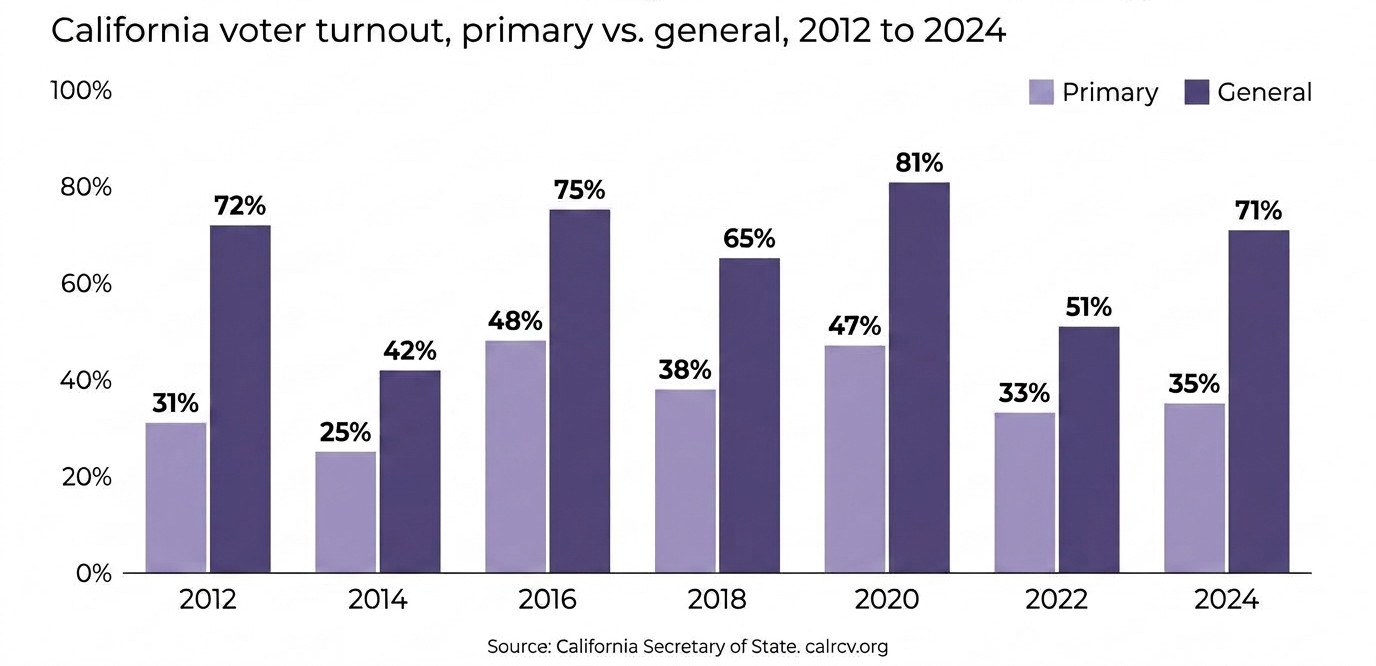
Top-two is billed as an open primary followed by a general election. In practice, it's a low-turnout election in March or June that usually decides the winner, followed by a November runoff.
The turnout gap shows up in every cycle. In 2022, 33% of registered voters cast a primary ballot, compared with 51% in November. In 2014, it was 25% versus 42%. Millions of Californians only vote in the fall, and by then their options are down to two.
Campaigns learned to pick their opponents
The most common move: boost a weak candidate from the other party, so you face them in November instead of a strong rival from your own.
In 2018, Gavin Newsom's campaign "attacked" Republican John Cox, raising Cox's name recognition and helping keep fellow Democrat Antonio Villaraigosa out of the general. In 2024, Adam Schiff ran ads "attacking" Steve Garvey, lifting Garvey past Democrats Katie Porter and Barbara Lee.
It works in both directions. In 2024, Republican Carl DeMaio promoted Democrat Kevin Juza in Assembly District 75 to avoid facing fellow Republican Andrew Hayes. It nearly worked. Hayes got 18.7% of the vote to Juza's 18.2%.
The cost lands on November voters. In a district that leans heavily one way, they lose the chance to choose between, say, a moderate and a progressive Democrat.
Vote-splitting can shut out voters
In 173 of 1,111 races (15.8%), both finalists came from the same party. Most were in safe districts. But sometimes a crowded field splits one side's vote and shuts it out entirely.
Take the 2022 primary for State Senate District 4. Six Republicans split 59.2% of the vote. Two Democrats advanced anyway, with 40.8% combined.
The report warned the same thing could happen in this year's governor's race, where a crowded Democratic field might split the vote and send two Republicans to November. It didn't: Xavier Becerra and Steve Hilton advanced. But the risk hasn't gone anywhere. The next crowded field could lock out either party's voters.
Who gets locked out
Top-two cuts candidates who finish in the top five but miss the top two. That falls hardest on candidates who already face steep odds.

Women: In 152 races (14%), at least one woman finished in the top five, but only men advanced.
Candidates of color: In 141 races (13%), a candidate of color finished in the top five, but none made the top two. Over 12 years, a top-five system would have put 630 more candidates of color on the November ballot: 277 Latino, 183 Asian, and 170 Black candidates.
Third parties: They reached November in just 19 races (1.7%), and 13 of those had no Republican running. Before top-two, the Green, Libertarian, Peace and Freedom, and American Independent parties averaged 127 primary candidates per election (1992 to 2010). In 2012 they fielded 17. In 2014, 13.
Turnout is part of the story. FairVote studies of Sacramento, San Bernardino, and San José found lower primary turnout among voters of color. When the primary is the real election, that gap shapes who reaches the ballot most people see.
The fix: Top Five with ranked choice voting
Keep the open primary. Send five candidates to November, not two. Let voters rank them, so the winner has both broad and deep support. Alaska already uses this system.

Top Five + RCV would:
Move the real choice to the higher-turnout November election.
Make it far harder for campaigns to handpick their opponents.
Take vote-splitting out of the general election.
Open a path for third-party and independent candidates.
Give voters more choices, including candidates from different wings of the major parties.
Read the full report
Read it on SSRN, dig into the data, and get involved with Cal RCV to help build a better way to vote in California.


